Showing posts with label Propaganda. Show all posts

The Butter is Gone


John Heartfield (Germany; 1891 – 1968)
The Butter Is Gone(c.1932)
Akademie der Kunste (Berlin, Germany)

Accompanying song: Die Gedanken Sind Frei (Our Thoughts Are Free)


Here, Heartfield bites back at the Nazi party and ridicules its inability to feed Germany. During a food shortage in '35 Herman Göring of the German Nazi party said, “Iron has always made a nation strong, butter and lard have only made the people fat”. In this picture Heartfield depicts Germans trying to eat weapons in lieu of the butter they're supposed to have. He criticizes the value of building up arms over providing food for a destitute Germany (Evans). Such photos were often depicted in the Arbeiter-Illustrierte-Zeitung, a weekly magazine, and reached a wide audience. Heartfield's radical images and thick coatings of satire served as a powerful tool in revealing to Germans the corruption and self-serving ways of the Nazi party.

"Mao" Series


Andy Warhol American (America; 1930-1987)
Mao Series (c. 1973)
Akron Art Museum, Ohio

Accompanying Song: Comfortably Numb by Pink Floyd


Andy Warhol’s silk-screened portraits of Mao were a reaction to the Chinese Cultural Revolution and Mao’s totalitarian propaganda. After Mao Zedong's rise to power, Chinese art was radically changed. Paintings were encouraged to be red, bright, and shinny while images of Mao became more and more idealized ("Cult of Mao"). Buildings were also plastered with colossal posters of leader Mao. In response to such restrictions and propaganda, Warhol rendered his own version of the famous poster. In his own creation, Warhol used flamboyant brushstrokes and arbitrary colors on Mao’s clothing and complexion to resemble graffiti. Such techniques boldly stated its rejection to Chinese censorship on art. Furthermore, the series also serves as commentary on the similarity of the communist public posters to capitalist advertising media (Art Institute of Chicago). Warhol’s work wages its own revolt against artistic suppression while opening the eyes of the public to the dangers of propaganda.

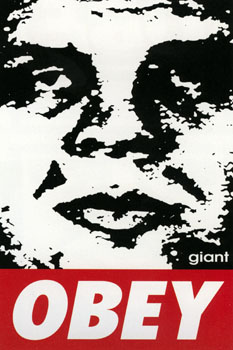
Obey Giant


Frank Shepard Fairey (America; 1970-Present)
Obey Giant (c.1993)
The Institute of Contemporary Art, Boston

Accompanying Song: I'll Go Crazy If I Don't Go Crazy Tonight by U2


The Obey Giant sticker campaign was an “experiment in Phenomenology”, says creator Fiarey. Fiarey wanted to draw attention to propaganda and the public willingness to swallow it down. The introduction of the Obey pictures challenged viewers to think critically of themselves in relation to their surroundings. Furthermore, it emphasizes a message about the path of least resistance: to obey or not to obey ("Shepard Fairey--Agent of Change"). The mass production of these stickers has proliferated society with this concept. Stickers may be stuck to walls on city streets and stencils of the image have even been seen on buildings. Like David’s mass reproduction of The Army of Jugs, the multiple copies make it more accessible to the public, so much so that one cannot ignore it. Fiarey’s campaign for questioning obedience acts as a grass root movement that advocates engaged thinking and rejection of passivity.