Showing posts with label Conformity. Show all posts

MoMA Poll


Hans Haacke (America; 1936-Present)
MoMA Poll (c. 1970)
The Museum of Modern Art (New York City, U.S.)

Accompanying Song: Another Brink in the Wall by Pink Floyd


This unique form of art behaves like a monument while introducing public interaction. The piece consists of a big poster board with the question "Would the fact that Governor Rockefeller has not denounced President Nixon's Indochina Policy be a reason for you not voting for him in November?" and two ballot boxes made of plexi-glass. The results yielded twice as many “yes” ballots than “no” ballots. The interactive aspect of t his work fuses it with plenty of power. It is no longer the sole creation of one person but is the resulting masterpiece of a collection of people. The public's involvement in this piece strengthens its statement and validity. Governor Rockefeller was a member MoMA's board of trustees at the time. This is the first work of Institutional Critique (critique of art institutions)(“Hans Haacke”). MoMA poll rebels against the structure of art institutions and refuses to conform to the institution's mandates. The issue may not be a huge movement, but Haacke's work represents art's ability to instigate change and to rally public favor.

Your Body Is A Battlegound


Barbara Kruger (America; 1945-Present )
Untitled (your body is a battleground) (c. 1989)
The Broad Art Foundation (Santa Monica, U.S.)

Accompanying Song: Rrriot Girl by Le Tigre


Kruger draws attention to society's lust for objectifying the female body. The silk screen poster applies the use of a negative to split the poster into halves. The end result criticizes the standard of symmetry applied to feminine beauty as well as the media obsession with advertising such benchmarks (The Broad Art Foundation). Furthermore, "Your Body is A Battleground" designates female ownership and even points to rightful power. The statement “Your body is a battleground” heralds that females can have control over their own bodies and must fight for their right. The simple yet stark poster sends a clear message about the divine rights women have over their bodies. Additionally, its bold statement encourages females to stand up against lies-spinning media and a shallow society.

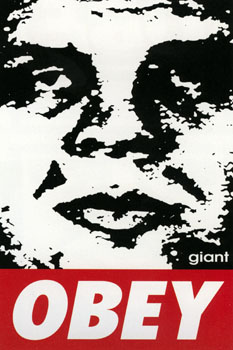
Obey Giant


Frank Shepard Fairey (America; 1970-Present)
Obey Giant (c.1993)
The Institute of Contemporary Art, Boston

Accompanying Song: I'll Go Crazy If I Don't Go Crazy Tonight by U2


The Obey Giant sticker campaign was an “experiment in Phenomenology”, says creator Fiarey. Fiarey wanted to draw attention to propaganda and the public willingness to swallow it down. The introduction of the Obey pictures challenged viewers to think critically of themselves in relation to their surroundings. Furthermore, it emphasizes a message about the path of least resistance: to obey or not to obey ("Shepard Fairey--Agent of Change"). The mass production of these stickers has proliferated society with this concept. Stickers may be stuck to walls on city streets and stencils of the image have even been seen on buildings. Like David’s mass reproduction of The Army of Jugs, the multiple copies make it more accessible to the public, so much so that one cannot ignore it. Fiarey’s campaign for questioning obedience acts as a grass root movement that advocates engaged thinking and rejection of passivity.